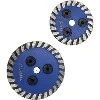
Using diamond tools for precise cutting has changed the way things are made in places where regular abrasives don't work well. Diamond abrasive wheels use man-made diamond bits attached to steel cores using resin, metal, or ceramic links. They are very hard (rated 10 on the Mohs scale), so they can remove material easily from hard metals, ceramics, glass, and carbide materials (rated 7–9 on the Mohs scale). These specialized grinding wheels solve important problems in the industry by making tools last longer (3-5 times longer than aluminum oxide wheels), cutting cycle times by 40–60%, and maintaining uniform measurement accuracy within ±0.001mm standards needed in the aircraft and medical device sectors.
Understanding the Challenges in Precision Grinding
Precision grinding operations keep running into problems that slow down production and lower the quality of the parts they make. Changes in material hardness, heat expansion during cutting, and uneven tool wear all lead to physical instability that hurts final parts. When makers use common abrasives like silicon carbide or aluminum oxide wheels, these problems get worse because they wear out quickly and need to be dressed more often.
Material Hardness and Surface Integrity
Abrasives that can keep cutting edges sharp over long production runs are needed for hard materials like tungsten carbide cutting inserts, ceramic bearings, and sharpened steel parts. When these materials are ground on traditional grinding wheels, they quickly lose their shape, which causes surface burns, micro-cracks, and dimensional shift. When processes don't have the right tools options, the rates of repair and scrap can hit 8–12%.
Thermal Management During Grinding Operations
When grinding, the workpiece's soundness is put at great risk by the heat that is created. Too high of temperatures can change the qualities of a material, create leftover pressures, and warp its dimensions in ways that make precision parts useless. To keep the rate of strong material removal constant while controlling the amount of heat used, grinding wheels need to be able to self-sharpen well and remove chips quickly. Diamond abrasives are better than other options at both of these tasks.
Tool Wear and Process Consistency
Unexpected tool wear makes it hard to keep track of the process and keep output plans on track. When grinding wheels lose their effectiveness in unpredictable ways, it's hard for manufacturing engineers to keep statistical process control. This variation makes it necessary to do more inspections, takes longer to set up, and raises the cost of each part. For businesses that want to follow lean production principles and meet just-in-time delivery promises, it's important to choose the right grinding options that give reliable wear patterns.
Evolution of Diamond Tool Technologies in Precision Grinding
When fake diamonds were first made in the 1950s, they started a slow but steady change in the precision grinding powers of the diamond tool. Early diamond grinding wheels used electroplating to attach single-layer diamond particles to steel bodies. This made them very good at cutting glass and ceramics. However, these early versions had short tool lives because the diamonds were not firmly embedded.
Advances in Bonding Systems
There are three main joining methods used in modern diamond grinding wheels. Each one is best for a certain type of application. At temperatures between 180 and 220℃, resin-bonded diamond wheels fix synthetic diamond particles in phenolic or polyimide matrices. This makes flexible bonds that are good for fine-finish grinding tasks that need a surface roughness of less than 0.2μm Ra. When bronze metals are fused at 750 to 850°C, they make hard structures that are perfect for form grinding and high material removal tasks. When ceramic links are heated to 1250 to 1400°F during sintering, they become very resistant to wear in harsh production settings.
Grain Size and Concentration Optimization
The choice of diamond grit has a big effect on how well grinding works. Coarse grits (40–80 mesh) remove stock quickly from carbide tools and hardened parts, while fine grits (200–400 mesh) make mirror finishes on medical implants and optical parts. Diamond content, which is given as a percentage by volume, finds a balance between how well the tool cuts and how much it costs. Standard concentrations are between 25% and 100%. Higher concentrations raise the original cost but make tools last longer in challenging situations.
Key Applications of Diamond Tools in Precision Grinding
Diamond grinding wheels are now necessary in many manufacturing fields where the material needs to be harder or the dimensions need to be more precise than what regular abrasives can do. Because they are hard, conduct heat well, and don't wear down easily, they can be used in ways that weren't possible before or were too expensive.
Carbide Tool Manufacturing and Sharpening
Diamond grinding wheels help companies that make cutting tools like tungsten carbide inserts, drills, and end mills get the sharp cutting edges and exact shapes that are needed for the tools to work well. Diamond wheels keep their shape accuracy over thousands of grinding cycles, which lets automatic production cells work with little control. Factory data from vehicle supply chains shows that a normal carbide insert production line using diamond grinding wheels gets 99.2% numerical uniformity, compared to 94.7% with silicon carbide options.
Ceramic Component Finishing
Because they are so hard and brittle, advanced ceramics used in electronics, aircraft, and healthcare uses are very hard to grind. Alumina, zirconia, silicon nitride, and silicon carbide ceramics can be ground with diamond wheels without damaging the edges or surface quality. Diamond cutting is widely used in the car industry to finish ceramic turbocharger parts, with surface finishes below 0.15 m Ra and production rates of more than 120 parts per hour.
Glass and Optical Manufacturing
For cameras, medical tools, and laser systems that need precise optics, grinding methods using a diamond tool must be able to make aspheric surfaces with accuracy of less than a micron. Resin-bonded diamond wheels with fine sizes (320–600 mesh) help makers meet these strict requirements while reducing damage below the surface that impacts optical performance. When compared to standard grinding and polishing processes, diamond particles' uniform cutting action cuts down on processing steps and shortens production cycles by 30 to 45 percent.
Stone Processing and Construction Materials
For edge shaping, surface smoothing, and artistic finishing, businesses that work with natural and man-made stones use diamond grinding wheels. Metal-bonded diamond pieces are used by companies that make countertops, monuments, and tiles because they can handle the roughness of granite, marble, and quartz. Longer repair times for these tools keep them working efficiently, which cuts down on machine downtime and labor costs in high-volume production settings.
Selecting the Right Diamond Tool for Your Precision Grinding Needs
When buying diamond grinding wheels, you need to carefully consider the technical specs, the supplier's skills, and the total cost of ownership. Buyers can get the most out of their equipment expenses and production by understanding how bond type, diamond quality, and application needs are related.
Comparing Diamond Grinding Wheel Types
The starting cost of electroplated diamond wheels is the lowest, and they work best for tasks that need complicated shapes or curves. Their single-layer diamond design shortens the life of the tool but makes it easy to do tasks like internal cutting and narrow slot operations. Resin-bonded wheels are perfect for precision grinding on carbide tools and ceramic parts where surface consistency is important because they balance the ability to cut with the quality of the finish. Metal-bonded wheels have the longest tool life and best shape retention, which makes their higher cost worth it in high-volume production settings where changing tools slows down work.
Supplier Evaluation Criteria
When looking for trusted diamond grinding wheel providers, you need to look at more than just the unit price. Quality approvals like ISO 9001 show that the manufacturing process is uniform, and expert help makes sure that the right wheel is chosen and that the application is optimized. Specialized grinding processes can benefit from suppliers that offer tailoring services, such as specific diamond ratios, bond formulas, and size requirements. Warranty terms, wait times, and minimum order amounts all have a direct effect on how inventory is managed and how flexible operations can be. This is especially true for small to medium-sized importers who are trying to make the most of their limited working capital.
Real-World Implementation Results
A medium-sized Ohio company that makes carbide cutting tools had consistent quality problems with regular grinding wheels. There was an 11% scrap rate and the machines often had to be shut down to change the wheels. The job got a lot better after switching to metal-bonded diamond grinding wheels that were specifically chosen for their carbide grade and grinding parameters. The rate of scrap fell to 2.8%, the time between wheel changes went from 120 parts to 580 parts, and the total efficiency of the equipment went up by 23%. The more expensive diamond wheels paid for themselves in just 4.2 months, and they saved more than $47,000 a year in scrap, labor, and tooling costs.
Maintenance and Optimization of Diamond Tools for Sustainable Performance
To get the most out of your purchases in diamond tool grinding wheels, you need to use regular repair methods and process improvement strategies. With the right care, tools last longer, keep working at a high level, and don't break down unexpectedly, which can lead to missed deadlines.
Cleaning and Contamination Prevention
The buildup of metal bits, fluid leftovers, and workpiece material between the diamond grits on grinding wheels is known as "loading." This pollution lowers the cutting efficiency, raises the grinding forces, and makes the workpieces more thermally active. Cleaning the wheel regularly with special treatment sticks or chemical solutions brings back its cutting action and porosity. Dressing resin-bonded wheels with aluminum oxide or silicon carbide sticks on a regular basis is helpful. On the other hand, diamond roll dressing is often needed for metal-bonded wheels to get new cutting edges. Keeping the right coolant percentage and filter in place stops contamination from building up, which means that you can go longer between deep cleaning sessions.
Wear Monitoring and Replacement Timing
Systematic checking of the state of the diamond grinding wheel stops quality loss and expensive scrap. A visual review shows clear signs of wear, including glass and loading conditions that need care. More advanced processes use power tracking systems that can tell when the grinding forces are going up, which means the wheel is wearing out.
Dimensional inspection of ground parts shows clear signs of form accuracy loss, which means the wheel needs to be replaced or fixed up. Setting replacement standards based on part count, measurement drift, or power usage makes it possible to plan proactive maintenance that keeps production running as smoothly as possible. Many companies keep track of the cost per part to find the best time to change the wheels so that the cost of the tool is balanced against the quality risks.
Parameter Adjustment and Process Optimization
Grinding factors have a big effect on how well and how long a diamond wheel lasts. For each material, bond, and application, the wheel speed, feed rate, depth of cut, and cooling flow rate need to be optimized. Conservative starting settings keep the wheels from getting damaged and allow for thorough testing to find the parameters that maximize output. Cutting depth has a big effect on how long a tool lasts. For example, cutting the depth by 30% can often add 60–80% to the wheel's life while keeping cycle times acceptable. Modern CNC grinding machines have programmed cycles that change conditions based on the stage of the process. This makes it easier to optimize parameters and make the best use of both tools and production.
Intelligent tools systems with built-in sensors for real-time state tracking are the way of the future for diamond cutting technology. These smart wheels will let machine managers know about wear levels, temperature profiles, and shaking patterns. This will allow flexible process control that improves performance and keeps tools from breaking. Improvements in bond materials, such as mixed resin-metal formulas and nanostructured ceramics, offer better performance by combining the best parts of standard bonding systems. These new developments will make diamond grinding wheels even more of the best choice for precise manufacturing companies that want to gain a competitive edge through advanced tools.
Conclusion
Diamond grinding wheels are a smart investment for companies that want to stay ahead of the competition by being precise, efficient, and high-quality. Their higher strength, longer tool life, and wide range of uses lead to measured gains in output measures, such as shorter cycle times, lower scrap rates, and more consistent dimensions. To make it work, you need to carefully choose a wheel that has the right bond type and diamond specs for the job.
You also need to work with dependable sources who can offer technical help and quick service. Systematic repair and process improvement get the most out of the money you spend on tools and get your operations ready for new smart manufacturing technologies. When manufacturing and purchasing workers look at precision cutting options, diamond tools should be at the top of the list for jobs that need to work with hard materials, tight limits, and strict production standards.
FAQ
What advantages do diamond grinding wheels offer compared to conventional abrasives?
Diamond grinding wheels work better than aluminum oxide and silicon carbide options in a number of ways. Their high hardness lets them work with materials that are harder than 8 on the Mohs scale, like carbides, ceramics, and sharpened tool steels. The tool lasts three to five times longer than regular wheels, which cuts down on the number of times it needs to be changed out and the time it takes to do so. Better thermal conductivity reduces the production of heat, which keeps the item from burning and warping.
How do I select the appropriate diamond grinding wheel type for my application?
The choice is based on the properties of the material, the desired surface finish, and the amount of output that needs to be done. Resin-bonded wheels work well for tasks that need very smooth surfaces on carbide and ceramic materials, with a roughness level below 0.4μm Ra. When tool life and shape retention are important enough to support higher starting costs, metal-bonded wheels work great in high-volume production settings.
What factors affect diamond grinding wheel lifespan and how can I maximize tool utilization?
How long a wheel lasts depends on its diamond concentration, bond strength, cutting factors, and how well it is maintained. Even though they cost more, higher diamond percentages last longer in tough situations. By adjusting the depth of cut, feed rate, and wheel speed to their best levels, you can keep up output and avoid premature wear. Cleaning it regularly stops loading, which lowers the cutting efficiency. Systematic tracking of wear lets repair happen at the right time, before quality starts to decline.
Partner with SNJ for Premium Diamond Tool Solutions
Grinding solutions backed by proven knowledge and quick support are what manufacturing operations that need accuracy, efficiency, and dependability deserve. SNJ makes high-performance diamond grinding wheels that can be used for a wide range of tasks in carbide casting, ceramics, glass processing, and building materials. The types of diamond wheels we can make are resin-bonded, metal-bonded, and electroplated, and you can change the diamond concentration, grit size, bond formulation, and physical limits.
We have been selling high-quality goods at low prices to importers, original equipment manufacturers (OEMs), and industry buyers all over North America since 2003. Our products meet international quality standards and have ISO approval. Our expert team gives you application-specific advice on how to get the best performance and value for your individual grinding needs. Contact Colin@sinodream.biz to talk about your precision grinding needs with experienced diamond tool makers who want to improve your manufacturing results by giving you better goods and reliable service.
References
1. Marinescu, I.D., Hitchiner, M., Uhlmann, E., Rowe, W.B., & Inasaki, I. (2006). Handbook of Machining with Grinding Wheels. CRC Press.
2. Jackson, M.J. & Davim, J.P. (2011). Machining with Abrasives. Springer Science & Business Media.
3. Malkin, S. & Guo, C. (2008). Grinding Technology: Theory and Applications of Machining with Abrasives. Industrial Press.
4. Marinescu, I.D., Rowe, W.B., Dimitrov, B., & Inasaki, I. (2012). Tribology of Abrasive Machining Processes. William Andrew Publishing.
5. Webster, J. & Marinescu, I. (2007). "Abrasive Processes" in Encyclopedia of Materials: Science and Technology, Elsevier.
6. Shaw, M.C. (1996). Principles of Abrasive Processing. Oxford University Press.