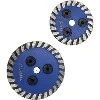
When it comes to woodworking, we all think of diamond saw blades, which are commonly used in woodworking. So do you know what are the production process tests?
1. Detection of hardness change of tooth seat after tooth welding. In the process of tooth welding, the saw blade selects three temperatures, and the hardness of the base remains unchanged when the base tooth seat is heated at 650 degrees. The hardness will only increase by 3-5 degrees when heated at 750 degrees. At 800 ℃, the hardness has reached 55-58 ℃, so the matrix is broken during cutting. The volume size of the generator with different tooth shape or thickness is also critical.
2. Detection of front and rear side angles of diamond saw blade. Many people choose a backup table when detecting the front side angle. When detecting the front side angle, it is affected by the change of the alloy undercut angle, or the change of the alloy length value. If the deformation of the matrix is added, or it is still not in the central circle, it is only an approximate reference value when measuring the front side angle with the point-type contact indicator. The side back angle is affected by the size and diameter of grinding wheel A and B. The five different changes of the grinding center line are essentially only a reference value, and the precise detection still requires the projection camera to be very accurate.
3. Weld tooth deformation detection. The thermal stress or cold tensile force of materials will change during the thermal change process. It is mainly caused by various factors such as material, temperature, cooling time, workpiece thickness and heating area. According to the cold measurement state of the substrate, the welding tooth will change due to the inevitable factors of the next process. At this time, we will conduct another inspection along the record mark according to the above recorded data again according to the above method, depending on its deformation. From the analysis, we can also see the harm of the welding tooth to the substrate deformation.
4. Run-off detection. There are three kinds of jerk states, one is the 180 degree eccentric height, the other is the left high right bottom or the right high left bottom, and the third is the left and right uneven height. The first is that the hole fit is too poor, and the matrix aperture is too large, resulting in 180 ° roundness; Second, as long as the base is not the center when grinding the tool, the left and right grinding heads are not grinding on the same center; The third is that the mechanical accuracy is not reliable on the quality of the grinding wheel or the grinding wheel is uneven.
5. End skip detection. The main reasons for the end jump of diamond saw blades are matrix elasticity and plastic deformation. The mechanical clip is uneven and may bounce, and the coordinate of the tooth extraction claw may be unstable. The micrometer is not allowed to measure the wave or pot state of the substrate due to the detection of grinding wheel quality, uneven, concave and convex surface, arc and other factors.